7 July 2026
MARTINI RÉINSTALLE L'APERITIVO ITALIEN
Read more

Consumer, Health, Lifestyle, Luxury
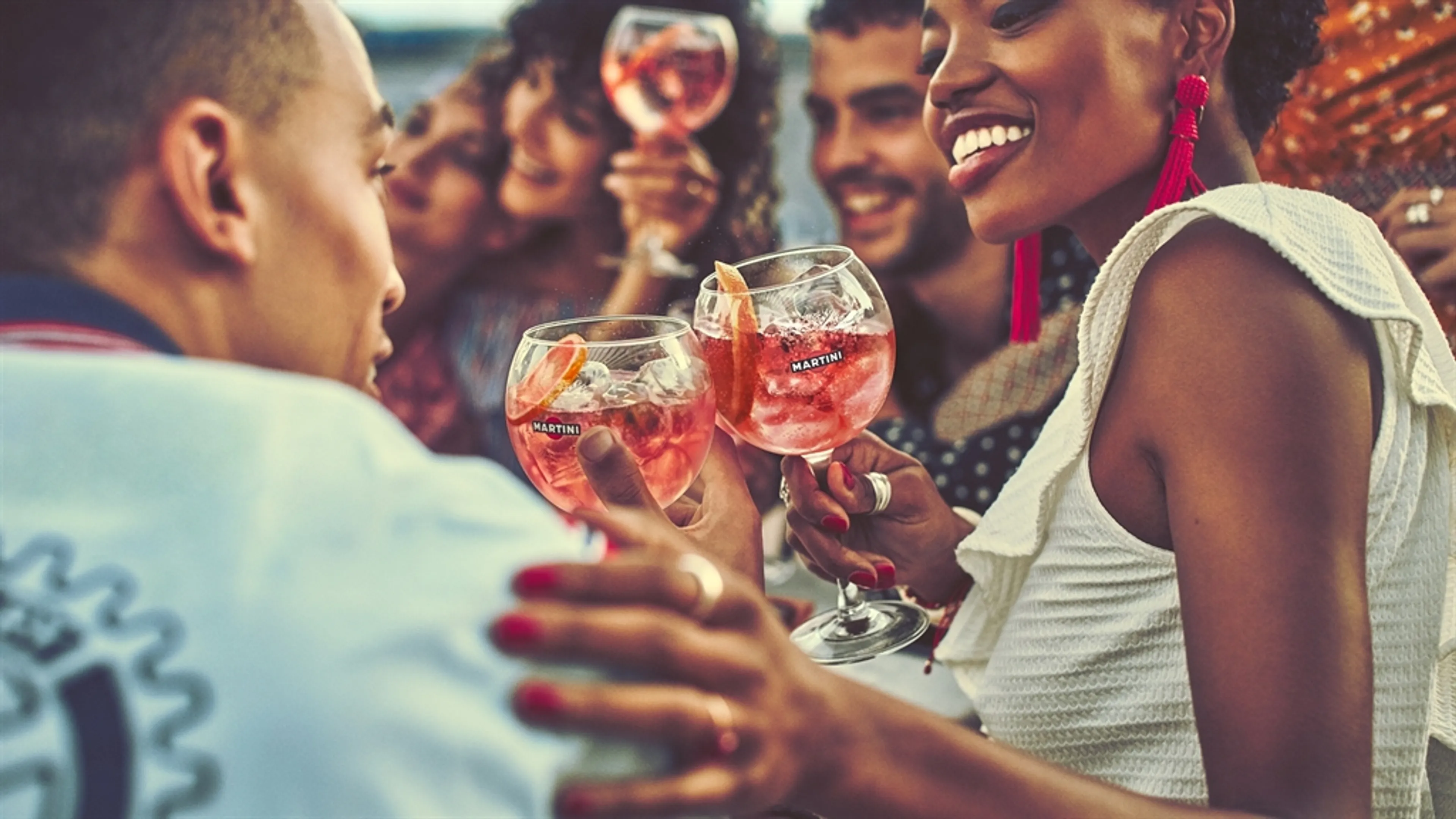
What occasion makes us feel happiest? According to new research from Italian drinks brand MARTINI, it doesn’t get better than laughing with friends, which triumphed over 19 other joy-inducing options in a survey taken by thousands of young adults across Spain, Italy, Germany and Belgium.
It turns out that going on holiday, achieving a work goal or even getting married can’t beat good times spent with friends, so why don’t we spend more time doing it?
As part of its new MARTINI TIME campaign, which heroes the power of connecting with close friends in the real world, the brand’s research provides the answer by shedding light on the myriad challenges of modern friendship. The research was developed in collaboration with trend forecasting agency Future Lab, with contributions from a series of experts and 4,000 25 to 34-year-old survey respondents across the four countries.
While laughing with friends may be the key to happiness, young adults today are facing a crisis in socialisation that means they spend less time with their friends than ever before.
Intimacy Gap
Technology has made it easier to stay in touch, but it has also allowed us to maintain the illusion of closeness without seeing our friends in person. MIT Professor Sherry Turkle explores this phenomenon in her most recent book, Alone Together: Why We Expect More from Technology and Less from Each Other, explaining: “The world is now full of modern Goldilockses, people who take comfort in being in touch with a lot of people whom they also keep at bay.”
The new research from MARTINI reveals that screen-only contact is eroding – and in some cases entirely replacing – quality time with the people we care about.
· Over a third of those surveyed spend more time communicating with friends online than in real life (Spain - 48%, Belgium - 38%, Germany - 35%, Italy - 33%)
· Over half spend between two to five hours a day scrolling through their friends’ social media feeds (Spain - 59%, Belgium - 52%, Germany - 52%, Italy - 50%)
· Over a third agree that it is harder to see friends in person since the dawn of social media (Spain - 43%, Germany - 38%, Belgium - 30%, Italy - 30%)
· Over a third learn more about their friends by following their lives on social media or online (Spain - 45%, Italy - 42%, Germany - 36%, Belgium - 35%)
· One in three admitted that technology and social media have made them feel lonelier than before they used them (Italy - 34%, Spain - 33%, Germany - 34%, Belgium - 26%)
Echoing these findings, Mahzad Hojjat – professor of psychology at the University of Massachusetts-Dartmouth – is wary of rising social media penetration and believes: “The cost is much fewer face-to-face interactions. Young adults don’t call each other. Calling someone nowadays is rude – you don’t call, you have to first text to make sure that it’s okay to call.”
Dis-Located Lives
The MARTINI report found that our increasingly mobilised lives and changing life stages, from being at university to starting our careers, mean that our future friendships will be tested more now than they have ever been. Whether moving away for study, work abroad or love, our friendships, especially those formed in our earliest years, and which form some of our closest bonds, will continue to be stretched to breaking point.
These collaged lives are translating through to collaged groups of friendships – groups of friends that are amassed through our varied lives, from university, post-graduate and MBA, first jobs and flatmates – which are far more numerous and diverse than previous generations. As our careers demand it, we will move further away from our family and friends.
Journalist Kate Leaver, another contributor to MARTINI’s report, commented: “People tend to be putting geographical distance between them and the people they would traditionally hang out with and go to for emotional support. I think it will be really interesting to see where that goes from here.”
This phenomenon is highly evident across Belgium, Germany, Italy and Spain, where varying reasons have led people to move away from their childhood homes and friendships.
· Three out of five of those surveyed see their friends less now than in their earlier adult years (Spain - 68%, Germany - 65%, Italy - 60%, Belgium - 56%)
· Three out of five do not see most of their oldest friends (Spain - 63%, Italy - 61%, Germany - 60%, Belgium - 54%)
· ‘No longer living close by’ was chosen as one of the top three reasons for finding it hard to see friends in person (Spain - 36%, Germany - 31%, Italy - 29%, Belgium - 29%)
· One in three stated that moving for work had challenged their close friendships (Spain - 36%, Germany - 33%, Italy - 33%, Belgium - 28%)
Across all four territories, research statistics support the trend towards living increasingly dislocated and mobile lives. 400,000 Belgians moved abroad for work between 2012 and 2016, while the number of young Spanish people living abroad grew by 79% between 2009 and 2017. In Germany and Italy, the number of students studying abroad and young adults working abroad has also risen dramatically.
Happiness Companions
Despite the challenges facing modern friendship, our social life has a vital impact on our happiness. MARTINI’s findings in this area are aligned with the views of experts like Emma Seppala, author of ‘The Happiness Track’, who believes that “social connectedness generates a positive feedback loop of social, emotional and physical wellbeing.”
· Across all countries surveyed, ‘laughing with friends’ was rated as the occasion that makes people happiest, above 19 other options such as ‘getting married’ or ‘achieving a work goal’
· Two out of three agree that spending time with friends makes them feel more resilient, energised, reassured and positive (Spain - 69%, Italy - 68%, Germany - 63%, Belgium - 61%)
· Over three-quarters have 5 or fewer people they count as ‘close friends’, suggesting a strong preference for small, close-knit social groups (Germany - 82%, Spain - 78%, Italy - 75%, Belgium - 75%)
· Across all countries surveyed, ‘trustworthiness’ was chosen as the most highly-valued quality in a friend, highlighting the crucial role that friends play as an emotional support structure
A new wave of scientific research is also revealing how vital friendship is to our overall health, with Susan Pinker – social science columnist for The Wall Street Journal – noting: “There is mounting evidence that a rich network of face-to-face relationships creates a biological forcefield against disease.” In her TED Talk, Pinker explains that real-world human contact stimulates the release of neurotransmitters, which act as a vaccine to protect us not only in the present but also into the future.
British physician Dr. Rangan Chatterjee agrees with Pinker’s view that the key to living longer lies in our social lives. His research into the world’s longest living people, a tribe in Okinawa, Japan, found that their concept of ‘moai’ – groups of five friends who commit to each other for life– is linked with their long lifespans. His advice is clear: “Meeting up with your friends is not a luxury, it is an absolute necessity for good health.”
Let’s Make Time
Real-world human connection is now recognised as essential to physical, mental and emotional wellbeing. Far beyond simply improving our mood, experts believe that our close relationships and level of social integration can be strong predictors of overall health and even how long we’ll live.
While the extended benefits of real-world friendship are certainly worth investing in, respondents across Spain, Italy, Germany and Belgium stated lack of time as the main reason why they struggled to see friends in person.
Nick Stringer, Global Brand Vice President of MARTINI, says: “If there is one thing that I hope people will take away from this research, it is the reminder to actively make time for close friends and enjoy the smaller moments in life that matter most. We are excited to be launching MARTINI TIME, to encourage friends to come together and enjoy food and drinks in the Aperitivo, as the benefits of real-life human interaction cannot be understated but are too often overlooked when life gets busy. Reconnecting with close friends is a conscious choice that enhances our lives in the moment but also over the long-term, leaving us with a prolonged sense of wellbeing and contentment that can last for days or even weeks.”
To read the full report from MARTINI and the Future Laboratory, please contact: XXXXX
-ENDS-
NOTES TO EDITORS
MARTINI’s ‘Power of Friendship’ research is part of the brand’s new MARTINI TIME campaign, which heroes the power of connecting with friends in the real world. MARTINI TIME is rooted in the aperitivo occasion – time spent in the late afternoon breaking bread and sharing drinks – but is also a celebration of everyday moments when people can be themselves in the company of those who matter most.
7 July 2026

10 December 2025

6 December 2025

6 December 2025